Description
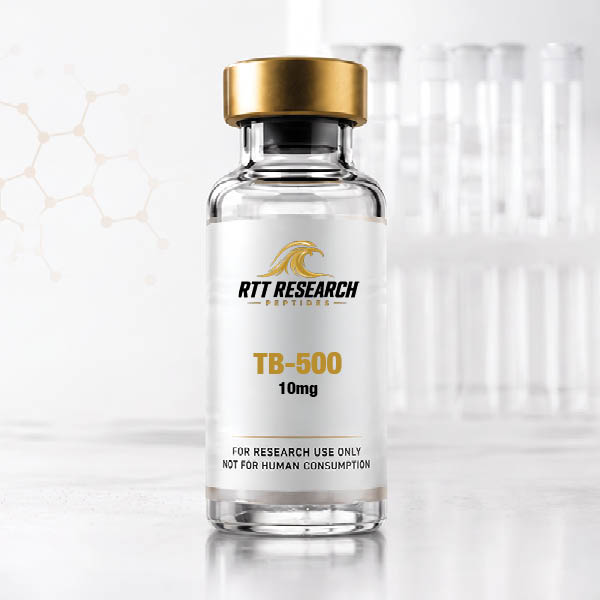
TB-500 — Thymosin Beta-4 Fragment Research Peptide
TB-500 commonly refers to an acetylated, seven-amino-acid fragment associated with thymosin beta-4, a naturally occurring peptide involved in actin-related cellular processes.
Scientific interest centres on how thymosin beta-4 and selected fragments influence cell movement and tissue responses in experimental models. The exact peptide sequence and chemical modifications matter: results obtained with full-length thymosin beta-4 cannot automatically be attributed to TB-500.
Research Highlights
Peptide fragment research: Investigation into a short sequence derived from thymosin beta-4.
Actin-related biology: Research connected to a region of thymosin beta-4 associated with actin interactions.
Cell movement: Exploration of cellular processes involved in migration and tissue organisation.
Tissue response models: Experimental studies involving thymosin beta-4 and related peptide fragments.
Structure and activity: Investigation into how peptide length and chemical modifications influence biological effects.
These highlights describe scientific research areas. They do not establish benefits or validate the quality of an individual research product.
Cell Movement & Actin-Related Research
Actin is a structural protein that helps cells maintain their shape and move. These functions contribute to many biological processes, including tissue organisation and responses to injury.
Full-length thymosin beta-4 interacts with actin. TB-500 corresponds to a short region within that larger peptide, creating interest in whether selected activities can be studied using a smaller fragment.
However, sharing part of a peptide’s sequence does not establish equivalent activity. Researchers must assess the specific compound rather than assume it reproduces all functions of the parent molecule.
Tissue Response & Wound Model Research
Research involving full-length thymosin beta-4 has examined cell migration, collagen deposition, and blood vessel formation in experimental wound models.
Related fragment research includes an animal study investigating the seven-amino-acid sequence LKKTETQ in aged mice. This provides a basis for further investigation, but it does not establish that commercially supplied, acetylated TB-500 produces the same effects.
TB-500 vs. Full-Length Thymosin Beta-4
Full-length thymosin beta-4 contains 43 amino acids. The compound commonly identified as TB-500 is the shorter, N-terminally acetylated fragment Ac-LKKTETQ.
Although related, these are distinct research materials. Differences in sequence, molecular size, and chemical modification can affect biological activity and stability.
When reviewing a study, researchers should confirm whether it used:
Full-length thymosin beta-4.
The unmodified LKKTETQ fragment.
The acetylated fragment commonly called TB-500.
Evidence for one form should not be presented as proof of another form’s effectiveness.
What Makes TB-500 Scientifically Distinct?
TB-500 provides a focus for studying how a short peptide fragment relates to the biological activity of a larger parent molecule.
This supports questions about which structural features contribute to particular experimental effects. Important uncertainties remain about its mechanisms, formulation, safety, and clinical relevance.
Considerations for Laboratory Researchers
When selecting research material, researchers should consider:
The exact amino-acid sequence and chemical modifications.
Documentation supporting identity and peptide content.
Whether analytical results correspond to the supplied batch.
The methods used and limitations of available testing.
Storage conditions and suitability for the intended protocol.
A purity percentage alone does not establish sterility, absence of endotoxins, or suitability for administration. Published research does not independently verify a supplier’s product.
Storage & Handling
Lyophilized powder — unopened vial
Follow the storage temperature specified on the product label and supporting batch documentation.
Protect from light and moisture.
Keep the vial tightly sealed until needed.
Avoid repeated temperature swings and freeze–thaw cycles.
These instructions apply to the unopened, lyophilized product. Storage conditions and usable periods after reconstitution require separate, formulation-specific guidance.
Frequently Asked Questions
What is TB-500?
TB-500 commonly refers to an acetylated, seven-amino-acid fragment of thymosin beta-4. The supplied material’s identity should be confirmed through its sequence and analytical documentation.
Is TB-500 the same as thymosin beta-4?
No. Full-length thymosin beta-4 contains 43 amino acids, while the fragment commonly identified as TB-500 contains seven. Their research findings are not interchangeable.
What is TB-500 being investigated for?
Research interest includes fragment-specific biological activity, actin-related processes, and cellular responses associated with tissue organisation. Much of the broader literature concerns full-length thymosin beta-4 rather than TB-500 itself.
Can thymosin beta-4 studies be used to describe TB-500?
They can provide background, but they must be clearly identified as research on a different molecule. They do not establish equivalent effects for TB-500.
What does the 10 mg label mean?
It refers to the stated peptide quantity per vial. It is not a recommended dose, concentration, or administration instruction.
Is this product intended for personal use?
No. This product is offered for laboratory research only and is not intended for human or veterinary administration.
Laboratory Research Only
Not for human or animal administration. Information on this page describes scientific research and does not provide medical advice, dosing instructions, or treatment recommendations. Research findings are not guarantees of experimental results.