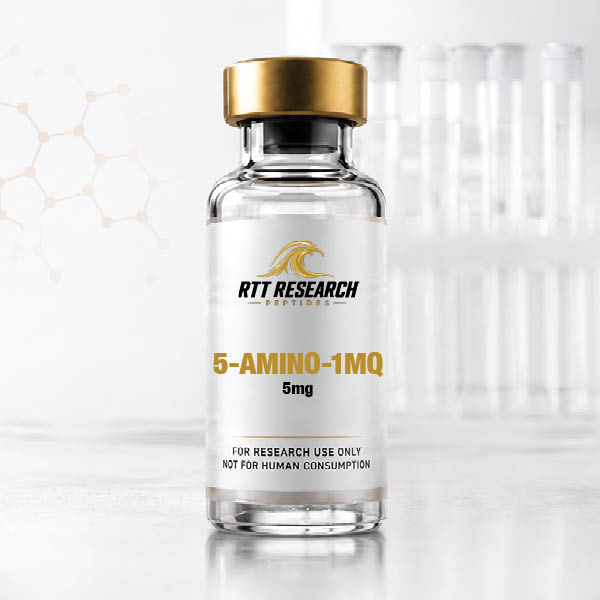
Description
5-Amino-1MQ — NNMT Inhibitor Research Compound
5-Amino-1MQ, also known as 5-amino-1-methylquinolinium, is an investigational small-molecule compound studied for its ability to inhibit nicotinamide N-methyltransferase (NNMT).
NNMT is an enzyme involved in the metabolism of nicotinamide and methyl-group transfer processes. Research interest centres on how changes in NNMT activity influence cellular metabolism, adipose tissue biology, and related biochemical pathways.
Unlike many other compounds in peptide research catalogues, 5-Amino-1MQ is not a peptide. It is a small-molecule enzyme inhibitor.
Research Highlights
NNMT inhibition: Investigation into the activity of nicotinamide N-methyltransferase.
Nicotinamide metabolism: Research examining the biochemical pathways associated with nicotinamide methylation.
Cellular energy regulation: Studies exploring interactions between NNMT activity and cellular metabolic processes.
Adipose tissue biology: Preclinical research investigating changes in fat-cell function and metabolic measurements.
Methylation pathways: Examination of biochemical reactions involving methyl-group transfer.
Preclinical evidence: Research remains largely laboratory- and animal-based, with insufficient human evidence to establish therapeutic safety or effectiveness.
These highlights describe research areas associated with the compound and do not establish benefits or validate the quality of an individual product.
NNMT Enzyme & Nicotinamide Research
NNMT is an enzyme that transfers a methyl group to nicotinamide and related molecules. The reaction involves S-adenosylmethionine as a methyl-group donor and produces methylated metabolites.
5-Amino-1MQ has been studied as an inhibitor of this enzyme, allowing researchers to investigate how reduced NNMT activity influences downstream biochemical processes.
Laboratory experiments have examined NNMT enzyme activity, intracellular metabolites, and changes in cellular responses under controlled conditions.
Cellular Metabolism & Energy Regulation
Cellular metabolism depends on interconnected processes involving nutrient availability, energy transfer, and biochemical signalling.
Research involving NNMT investigates relationships between nicotinamide metabolism, methylation reactions, and metabolic regulation.
5-Amino-1MQ has been used in experimental models examining these relationships. The findings provide a basis for further scientific investigation but do not establish beneficial effects in humans.
Adipose Tissue & Preclinical Research
Adipose tissue plays a role in energy storage and metabolic signalling. Changes in the activity of metabolic enzymes can influence cellular behaviour within experimental systems.
Published research has investigated 5-Amino-1MQ in cultured adipocytes and animal models of diet-induced metabolic dysfunction.
These studies have evaluated changes in metabolic markers, body composition, and tissue-related outcomes under controlled experimental conditions.
Results obtained in animals should not be interpreted as evidence that the compound produces equivalent effects in humans.
What Makes 5-Amino-1MQ Scientifically Distinct?
5-Amino-1MQ differs from receptor-targeting peptides because it is investigated primarily as a small-molecule enzyme inhibitor.
Its research focus is NNMT activity rather than GLP-1, GIP, growth hormone, or other peptide receptor systems.
This distinction is important when comparing mechanisms and interpreting findings across different areas of metabolic research.
Considerations for Laboratory Researchers
When selecting research material, researchers should consider:
Documentation confirming compound identity and chemical form.
Whether analytical results correspond to the supplied batch.
Appropriate methods for evaluating purity and chemical composition.
Storage, stability, and handling requirements.
Suitability for the intended laboratory protocol.
Researchers should confirm the precise chemical form, including any counterion or salt designation, because these details affect molecular composition and analytical interpretation.
Storage & Handling
Unopened research material
Follow the storage temperature specified on the product label and supporting batch documentation.
Protect from light and moisture as specified for the supplied chemical form.
Keep containers tightly sealed until needed.
Avoid unnecessary exposure to changing environmental conditions.
Stability and storage requirements should be established from documentation specific to the supplied material.
Frequently Asked Questions
What is 5-Amino-1MQ?
5-Amino-1MQ is an investigational small-molecule compound studied for its ability to inhibit the NNMT enzyme.
Is 5-Amino-1MQ a peptide?
No. It is a small molecule rather than a chain of amino acids.
What does NNMT stand for?
NNMT stands for nicotinamide N-methyltransferase, an enzyme involved in nicotinamide metabolism and methyl-group transfer.
What is 5-Amino-1MQ being studied for?
Research includes NNMT inhibition, cellular metabolic regulation, adipose tissue biology, and related biochemical pathways.
Has 5-Amino-1MQ been proven effective in humans?
Its evidence base remains predominantly preclinical. Laboratory and animal findings do not establish therapeutic effectiveness or safety in humans.
What does the 5 mg label mean?
It refers to the stated amount of research compound. It is not a recommended dose, concentration, or administration instruction.
Laboratory Research Only
Not for human or animal administration. Information on this page describes scientific research and does not provide medical advice, dosing instructions, or treatment recommendations. Research findings are not guarantees of experimental results.