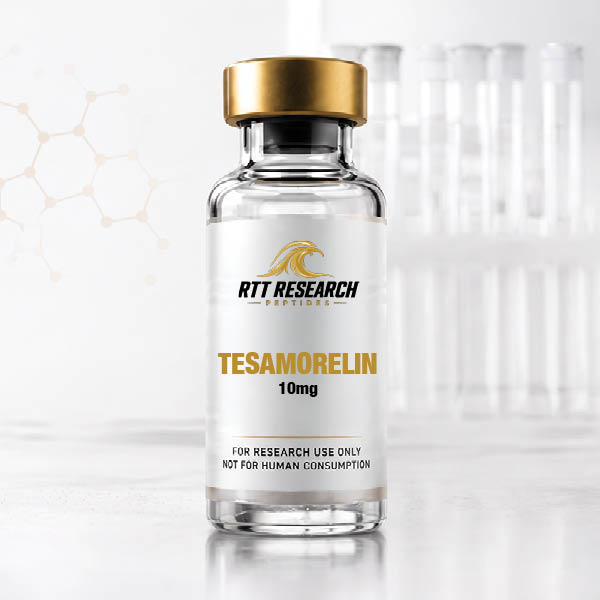
Description
Tesamorelin — Growth Hormone-Releasing Hormone Research Peptide
Tesamorelin is a synthetic analogue of growth hormone-releasing hormone (GHRH), a naturally occurring hormone that regulates growth hormone secretion from the anterior pituitary gland.
Scientific research has investigated tesamorelin’s activity within the growth hormone signalling system, including its relationship with insulin-like growth factor-1 (IGF-1), visceral adipose tissue, and metabolic regulation.
Clinical findings associated with a specific pharmaceutical formulation do not establish the identity, quality, or suitability of other products bearing the same compound name.
Research Highlights
GHRH receptor activity: Investigation into signalling through growth hormone-releasing hormone receptors.
Pituitary research: Studies examining the regulation of growth hormone secretion.
IGF-1 signalling: Research assessing downstream hormonal responses associated with growth hormone activity.
Adipose tissue research: Clinical investigation into visceral fat and related metabolic measurements.
Liver metabolism: Research examining liver fat and metabolic changes in selected study populations.
Safety evaluation: Investigation into glucose regulation, hormonal responses, and potential adverse effects.
These highlights describe scientific research areas and do not validate the safety, effectiveness, or quality of an individual research product.
Growth Hormone & Pituitary Signalling Research
Growth hormone secretion is regulated through several interacting hormonal systems. GHRH stimulates receptors in the anterior pituitary gland, contributing to the physiological regulation of growth hormone release.
Tesamorelin acts as a GHRH analogue and has been studied for its influence on this signalling process.
Researchers examine changes in growth hormone and IGF-1 as part of investigations into endocrine regulation and downstream metabolic responses.
Visceral Adipose Tissue & Metabolic Research
Visceral adipose tissue is located within the abdominal cavity and has important relationships with metabolic and cardiovascular health.
Clinical investigations involving tesamorelin have examined visceral adipose tissue in people with HIV-associated lipodystrophy. Research has also explored relationships between growth hormone signalling, adipose tissue distribution, and metabolic measurements.
These findings apply to the populations, formulations, and conditions studied. They do not establish general weight-management benefits or equivalent effects for independently supplied research materials.
Liver Metabolism & IGF-1 Investigation
The liver contributes to energy metabolism and produces IGF-1 in response to growth hormone signalling.
Tesamorelin research has examined hepatic fat, circulating IGF-1, and selected indicators of metabolic function.
Safety investigations also consider potential changes in glucose regulation and the effects of sustained alterations in growth hormone-related pathways.
What Makes Tesamorelin Scientifically Distinct?
Tesamorelin acts through the GHRH receptor and influences endogenous growth hormone secretion.
This distinguishes it from somatropin, which is a form of human growth hormone, and from compounds such as ipamorelin, which act through a growth hormone secretagogue receptor pathway.
These compounds should not be considered interchangeable because their molecular structures and mechanisms differ.
Considerations for Laboratory Researchers
When selecting research material, researchers should consider:
Documentation supporting peptide identity and content.
Whether analytical results correspond to the supplied batch.
The methods used and limitations of available testing.
Formulation-specific stability and storage information.
Suitability for the intended laboratory protocol.
A purity percentage alone does not establish sterility, absence of endotoxins, or suitability for administration.
Storage & Handling
Unopened research material
Follow the storage temperature specified on the product label and supporting batch documentation.
Protect from light and moisture where required by the formulation.
Keep the container sealed until needed.
Avoid repeated temperature fluctuations.
Storage conditions and usable periods after reconstitution require formulation-specific documentation. Instructions from an authorized pharmaceutical product should not automatically be applied to a different formulation.
Frequently Asked Questions
What is tesamorelin?
Tesamorelin is a synthetic growth hormone-releasing hormone analogue investigated for its effects on pituitary signalling and metabolic regulation.
Is tesamorelin human growth hormone?
No. Tesamorelin acts through GHRH receptors to influence endogenous growth hormone secretion. It is not human growth hormone itself.
What is tesamorelin being studied for?
Research includes growth hormone and IGF-1 signalling, visceral adipose tissue, liver fat, and selected metabolic outcomes.
Is tesamorelin the same as ipamorelin?
No. The compounds act through different receptor systems involved in growth hormone regulation.
What does the 10 mg label mean?
It refers to the stated peptide quantity. It is not a recommended dose, concentration, or administration instruction.
Does published clinical research establish the quality of this product?
No. Published clinical findings do not independently verify the identity, formulation, or quality of a separate research product.
Laboratory Research Only
Not for human or animal administration. Information on this page describes scientific research and does not provide medical advice, dosing instructions, or treatment recommendations. Research findings are not guarantees of experimental results.